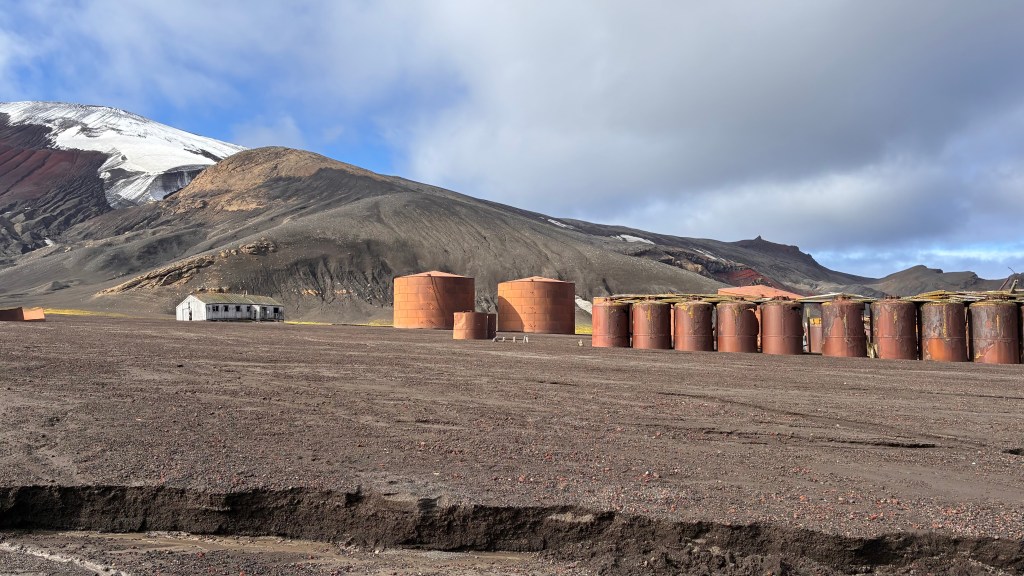
Antarctica is the cleanest place I have ever been, and also one of the best-preserved scrapyards. Because decay happens so slowly in the cold, dry climate, the traces of past human activity survive for decades or longer: wooden huts, water boats, mooring chains, whaling equipment, barrels half-buried in scree. This raises a question that sounds academic but has practical consequences. When does rubbish become heritage? My answer is that it is always a choice, and we should be honest about who makes it.
Under the Antarctic Treaty System, certain places and objects are officially listed as Historic Sites and Monuments. They include huts from the so-called heroic age of exploration, early scientific stations and other sites associated with important events. Once listed, they are protected: visitors cannot remove or damage them, and some are actively conserved.
At the same time, Antarctica’s environmental rules require that waste be removed and old sites cleaned up. So two principles pull in opposite directions. One says: preserve the traces of human history. The other says: remove human mess from a protected wilderness. Every rusting oil drum sits somewhere between those two rules, and someone has to decide which side it falls on.
Looking at what gets chosen is revealing. The huts of famous explorers are carefully conserved. The everyday equipment of whalers, sealers and station workers is more likely to be seen as debris. In other words, heritage tends to follow fame and national pride. That is not unique to Antarctica; it happens with heritage everywhere. But in a place with no indigenous population and a short human history, the bias is especially visible.
I do not think the answer is to keep everything. A continent full of preserved rubbish would help no one. But I would argue for a wider view of what counts as history. The industrial traces of whaling, the remains of ordinary working life, the objects that show what humans did to this place and not only what they discovered, all of these tell part of the story. Keeping some of them, in a few well-chosen places, would give future visitors a more honest picture.
Walking past weathered barrels and iron bollards on an Antarctic beach, you are reminded that exploration is never purely heroic or abstract. It leaves behind tools, shelters and scrap. What we choose to save, and what we choose to clear away, will shape how the next generations understand our arrival at the end of the Earth.


Leave a Reply