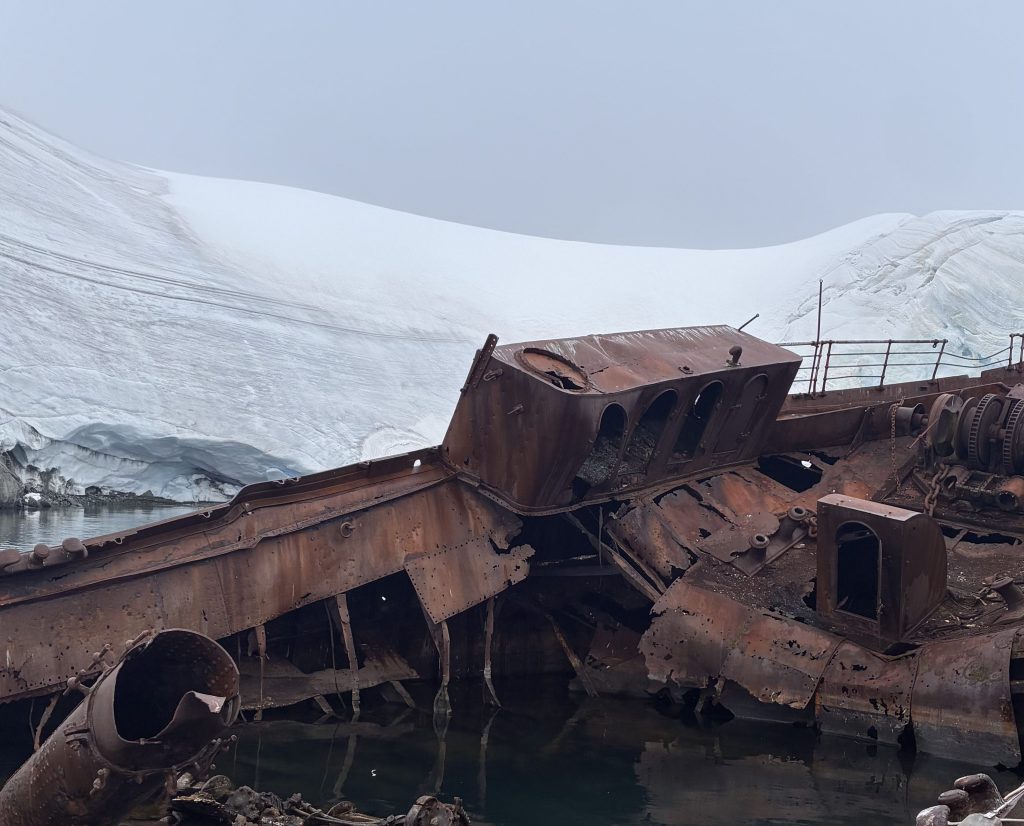
In Foyn Harbour, at Enterprise Island in Wilhelmina Bay, the rusted hull of the Guvernøren rises from the water. Built in Belfast in 1891 as an ocean liner and later converted into a Norwegian whale-factory ship, she caught fire in January 1915 while carrying thousands of barrels of whale oil. Her captain ran her aground so the whole crew could escape. More than a century later, she is one of the most photographed sights on the Antarctic Peninsula. My argument is that we tend to look at her the wrong way: as a romantic ruin, when she is really evidence.
It is easy to see why the wreck charms visitors. Iron ribs and a weathered superstructure stand out of clear, icy water. Antarctic terns nest on rusted fittings. Kelp moves in the shallows under the bow. Small boats can come right alongside, and in good light the scene looks almost like a sculpture. People come back with beautiful pictures and a vague sense of history.
But the Guvernøren was not an explorer’s ship. She was a factory. Her job was to process whales caught in these waters into oil, as efficiently and in as large quantities as possible. In the early twentieth century, the Southern Ocean was the centre of an industry that hunted whale populations close to collapse. The barrels of oil that fuelled her fire were the product of that industry. When we call her a “ghost ship”, we soften what she actually represents.
As an anthropologist, I find this gap between appearance and meaning fascinating. Ruins tend to become picturesque with time. Rust and decay make industrial objects look peaceful, even innocent. The same happens with old mills, mines and military sites around the world. The danger is that the picture replaces the story, and we forget why the object is there.
There is also a hopeful side, and it is worth saying clearly. Today, whales feed in the same bays where the factory ship once worked. Watching humpbacks in Wilhelmina Bay, within sight of the wreck, is a powerful reminder that recovery is possible when people decide to stop.
So if you visit, by all means take the photograph. But take a moment to read the hull as a document as well as a sight. The Guvernøren is a monument to a time when the Southern Ocean was seen mainly as a resource. Remembering that is part of what keeps it from being seen that way again.


Leave a Reply