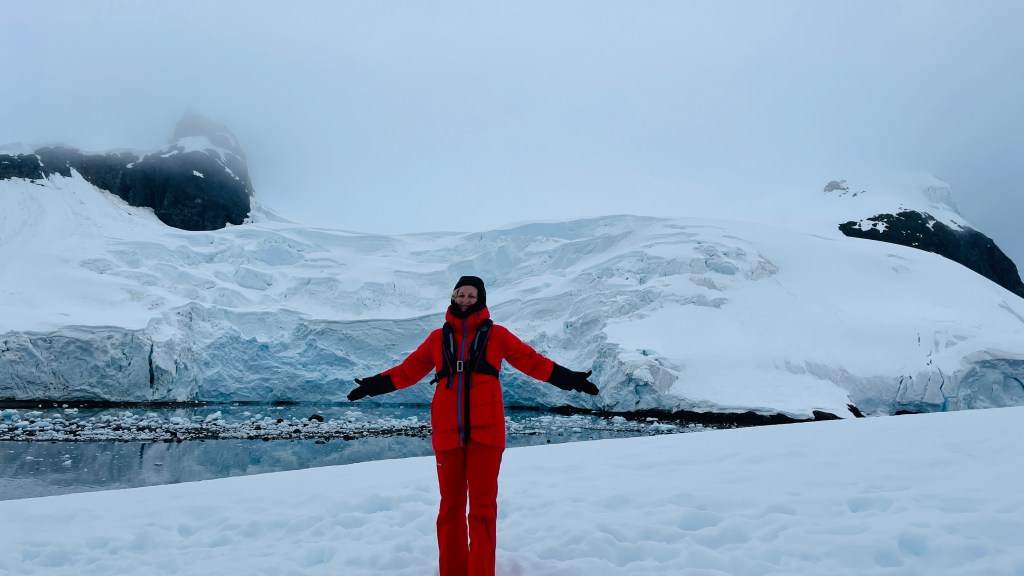
Our eyes are trained in landscapes full of clues. Trees, houses, roads and telephone poles constantly tell us how far away things are and how big they are. In Paradise Bay, on the west coast of the Antarctic Peninsula, those clues disappear. What remains is ice, rock, water and sky. My point in this post is practical as much as poetic: in Antarctica your sense of scale fails, and that is not just beautiful. It is a safety issue.
A glacier front that looks a few hundred metres away may be two kilometres off, and its ice cliff may be sixty metres high. A piece of ice that looks like a pebble next to the hull can be the size of a cottage. Without familiar objects to compare with, the brain guesses, and it guesses wrong. Usually it underestimates distance and size, which is exactly the wrong way round when you are in a small boat.
This matters because ice is not static. Glaciers calve: large pieces break off without warning and fall into the sea, sending out waves that can swamp a small tender. Icebergs roll over as they melt unevenly. Brash ice drifts with the wind and current and can close an anchorage that was clear an hour earlier. The sensible rule is to keep much further from ice than your eyes suggest, and to trust radar, charts and the depth sounder over your instinct.
Sound misleads too. When the engine is off and the anchor holds in sheltered water, Antarctica seems completely silent. It is not. There is the sudden crack of calving ice, which can sound like a gunshot. There is the soft fizzing of old air escaping from melting ice as it drifts past the hull. And now and then there is the explosive breath of a humpback whale surfacing nearby. Each one tells you something about what is happening around the boat, if you are paying attention.
Watching humpbacks feed in those mirror-calm coves, their dark flukes lifting against reflections of snow-covered peaks, is one of the most remarkable things I have seen. It also taught me something about attitude. In a landscape operating on geological time, you are a very temporary guest. The right posture is not conquest or even adventure. It is stillness and attention.
That lesson travels well beyond Antarctica. Whenever we are somewhere truly unfamiliar, our judgement is less reliable than it feels. The honest response is to slow down, check what you think you know, and give the place more room than you think it needs.


Leave a Reply